













People like Steve Weber are Google’s worst nightmare. Last November, Weber self-published a book about how to sell used books on the Internet.
To promote it, Weber created a three-line text ad that ran on Google Inc.’s site as a sponsored link when people searched for any word, or phrase, in his book’s index.
Each time a consumer clicked his ad, Weber paid Google anywhere from 50 cents to 75 cents.
Weber’s marketing campaign cost about $4,000 through the end of the year. “But my conversion rate of click-thrus to actual sales was less than 2 percent,” says the Falls Church, Va., resident, who also runs an online used-book store. “By my figuring, that means I spent upwards of $100 for each $20 sale.”
Unable to make a living on those economics, Weber dropped the Google ads and instead started a blog about bookselling, posting as many as one or two new items a day. Soon, Weber’s site was recording more than 100 first-time visitors daily, many of whom signed up to receive an e-mail version of the blog each time it was updated. Through the blog, Weber sold many more books than he did during his attempts at keyword advertising. “Ironically, most people came to my blog from
Google,” Weber says. “Using Google as a free search engine to sell books was much more lucrative than paying for advertising.”
Nobody would argue that Internet advertising is anything but a robust market. In 2005, Internet advertising revenues rose to an estimated $12.5 billion, a 30 percent increase over the year before, according to the Interactive Advertising Bureau and PricewaterhouseCoopers. Forrester Research Inc. projects that by 2010, the Web ad market will reach $26 billion, or 8 percent of total ad expenditures. Meanwhile, shares in Google, the only pure-play online ad company, have posted one of the most lucrative post-IPO performances in decades; the stock’s price-to-earnings ratio was a stratospheric 68 just 16 months after going public.
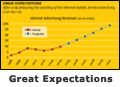
Yet, despite these results, Weber’s experience reveals a dirty little secret about online advertising that many large and small companies have discovered—and that Google, Yahoo! Inc., Microsoft Corp. and any number of other online advertising outfits would prefer to keep under the radar: Response rates can still be disappointingly low. A typical search-engine ad will likely attract, at best, a mere 1 percent to 2 percent of Web surfers who see it, while the response rate for banner ads is well below that, and falling rapidly. And just a small fraction of the people who click through will actually make a purchase, according to Internet marketing experts. In other words, online advertising is about as efficient as a direct-mail campaign.
Of course, a direct-mail campaign would cost quite a bit more than keyword advertising. But the Internet was supposed to far outshine, not merely equal, traditional marketing approaches, thanks to its unique ability to target consumers based on their specific, immediate interests exposed during Web activity. That revolutionary relationship with potential customers, alone, was expected to make the Web the most lucrative marketing medium yet. Now, however, even Internet marketing partisans concede that new ways to deliver online messages and accurately identify potential customers—many of which are in development or just beginning to emerge—are desperately needed before advertisers can realize an acceptable payoff.
“We’re just in the first inning of Web advertising,” says Matt Moog, president and CEO of Q Interactive, a Chicago-based online ad agency that specializes in generating leads through discount coupons and promotions. “Web advertising has a long way to go before it reaches its potential and provides the sort of returns advertisers want. We have to get response rates well over 10 percent before Web marketers can claim that we’re doing a good enough job.”
Story Guide:
Online advertising shows its age