













Almost everything about the new Boeing 787 is different—from the cutting-edge materials and electronics used to build the plane, to the technology used during the design and assembly process. It is so different, in fact, that even the Boeing Co. itself—a fixture in the global economy for nearly a century—is undergoing a radical transformation as it builds this next-generation jet.
The design and production strategy employed by the $55 billion, Chicago-based aerospace giant to get the 787 built as quickly and economically as possible involves an unprecedented degree of collaboration between Boeing and its partners around the world—partners who are participating in the actual design of the plane. All of which marks a shift in the way Boeing defines itself: The company is no longer just a manufacturer, but also a high-end systems integrator. “We are a technology company,” says Scott Griffin, Boeing vice president and CIO.
The reasons Boeing is making the shift go beyond the savings it hopes to enjoy by making the planes faster and cheaper. The company is also spreading the costs of design and development throughout its partner network, and building global relationships that may, in turn, help the company sell its planes overseas.
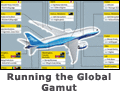
The previous state of the art in aviation manufacturing was to have global partners work from a common blueprint to produce parts—actually, whole sections of the airplane—that were then physically shipped to a Boeing assembly plant near Seattle to see if they fit together. There, successive iterations of the planes were built and refined with onsite teams from around the world.
On the 787, that process has gone the way of the biplane. Instead, parts are designed concurrently by partners, and virtually “assembled” in a computer model maintained by Boeing outside its corporate firewall. “We have different people building different pieces by creating data that is assembled and checked in real time,” says Griffin, who is responsible for the computer systems that make this process possible. Ultimately, completed sections of the plane will be picked up by three specially fitted 747s and carried to a Boeing facility in Everett, Wash. Thanks to the online modeling, Boeing can now trust its global partners with the process of creating entire sections of the plane, from concept to production.
“The design is occurring in Japan, Russia, Italy, the U.S.,” Griffin says. “This is not merely a PowerPoint or SharePoint collaboration, or looking at two-dimensional drawings to see if a company can bid on a contract. This is big companies like the Japanese heavies, and our Russian design center, and Boeing in Everett working together. This is something that creates competitive advantage.
“This kind of collaboration has taken a huge amount of time out of the process,” he adds. “It’s where the big savings are.”
The competitive advantage is critical to Boeing, which is locked in a global battle for market leadership with Airbus S.A.S., the Toulouse, France-based aerospace manufacturer that has emerged as its most potent competitor for civil aviation business in the modern era. Boeing has 291 firm orders, and 88 commitments, from 27 airlines for the new 787, nicknamed the “Dreamliner,” which will seat from 250 to 330 passengers in varying configurations. List price: around $150 million per plane.
“The importance of the 787 to Boeing’s success in the coming years simply cannot be overstated,” says Bill Dane, senior aviation analyst at Forecast International Inc., an aerospace industry research firm in Newtown, Conn. “It is no hype to say that the 787 is the company’s future.” In an industry characterized by epic bets and enormous risks, says Howard Rubel, a managing director and aerospace analyst at Jefferies & Co., in New York City, “The 787 is a defining program for Boeing.”
And a defining element of that program is a new level of global collaboration.
Story Guide:
Boeing: New Jet, New Way of Doing Business
Next page: From Manufacturer to Integrator