













It was an unusual step driven by an extraordinary flop. Hershey Foods Corp.’s $112 million SAP implementation in July 1999 had failed so miserably that by the following March, then-chairman Kenneth Wolfe felt he had to address the pain felt by employees and customers. “It has not been the easiest journey,” he wrote in the company’s proxy statement. “Time will give us perspective. As we resolve our problems, the frustrations will fade.”
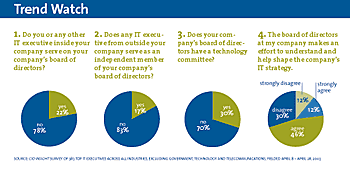
Hershey’s board of directors wasn’t so sanguine; the board was stunned as profits fell by $32 million in the second half of 1999, owing to the SAP mess. The board’s nominating committee recruited Allan Loren, then CIO of American Express Co., to stand for election to the board in 1999. Loren became the board’s only IT veteran.
Was the courtship of Loren, now CEO of Dun & Bradstreet Corp., spurred by the SAP difficulties? “It sure was,” says John Pietruski, who retired as chairman of the Hershey board’s nominating committee in April 2003. “It’s become a much more technology-driven world, and the board felt it needed to have someone with particular competence in that area.”
Pietruski, former CEO of Sterling Drug Inc. and now chairman of Texas Biotechnology Corp. in Bellaire, Texas, notes that several CEO directors at Hershey had overseen SAP projects at their own companies. “The board was not blind in this area,” he says. Still, he adds: “There’s a difference between being a CEO overseeing the implementation and being a CIO having direct operating experience.”
If ever there was a signal to the boards of corporate America that information technology expertise might be climbing within the portfolio of skills that directors at non-IT companies need, consider IT meltdowns in recent years at companies from Hershey and Kmart Corp. to Oxford Health Plans and Nike Inc. Oxford, for example, lost 70 percent of its market valuation after failures of its electronic billing and receivables systems. Supply-chain software problems cost Nike $100 million in sales.
At Hershey, Y2K fears had executives rushing to implement its SAP program before New Year’s Day 2000, but Hershey cut too many corners, failing to first adequately smooth the wrinkles from customer service, warehousing and order fulfillment systems. Over the critical back-to-school/Halloween/Christmas period in 1999, warehouses were chock full of Kisses and Bites—and they stayed that way: Due to system problems, Hershey couldn’t get enough candy to retail stores. In the third quarter, the company’s year-over-year sales fell a staggering 12.4 percent, followed by a fourth-quarter decrease of 10.8 percent. In all, the fiasco accounted for $285 million in lost sales.
To be sure, the Hershey meltdown didn’t create a mad rush to recruit CIOs for board duty. But that incident and others reinforced the notion that nominating committees should consider filling at least one board seat with an IT-wise executive. Business and technology analysts also say last summer’s passage by Congress of the Sarbanes-Oxley Act, which calls for companies to cough up more timely, accurate and detailed accountings of their financial health, presents another reason to have IT representation on the governing board. “The trend of CIOs joining boards is not yet what I’d call a full-fledged revolution, but I think Sarbanes-Oxley has put some additional fuel behind it,” says Harriet Edelman, CIO of Avon Products Inc., and a member of Hershey’s board. Adds Vaughan Merlyn, vice president of Kingwood, Texas-based Concours Group, a management consulting company: “Why should corporate boards care about IT? Because IT is at the heart of business performance, differentiation and value. It’s hard to find a major business process initiative these days that does not involve IT.”
Indeed, with up to 50 percent of a company’s capital expenditures being spent on information technology, shouldn’t a board include a technology maven who can provide the kind of expertise, front-line IT experience and insight that most business-trained board members lack? “It’s a progressive board that understands they need some IT talent around the table,” says Cinda Hallman, the ex-CIO of DuPont and now president and CEO of Fort Lauderdale, Fla.-based recruiting firm Spherion Corp. Mark Polansky, senior client partner in recruiter Korn/Ferry International’s IT sector in New York, notes: “The concept of having a technologist on the board is becoming more widely accepted.”
Sure, some non-tech boards are still more interested in finding financial experts than technology insiders to meet Sarbanes-Oxley’s provisions—despite the act’s direct potential impact on corporations’ information accountability and financial reporting systems. “Most boards are fairly focused on looking for financial executives for the audit committee,” says Julie Daum, practice leader for Spencer Stuart’s North American Board Services in New York.
But Daum says CIO recruiting “is a trend I think we’re going to see more of.” About 3 percent of Daum’s director searches last year ended up putting a CIO or CTO in a board seat; just three years ago, that number was was closer to zero. One reason for the change: The pool of CEO-level candidates is shrinking, leading board recruiters to look at other C-level executives, Daum and others say. Second, institutional investors are pushing boards to acquire IT expertise. “Technology is tremendously important to every company, and we want to see that expertise on the board,” says Nell Minow, a leading advocate of corporate governance reform and cofounder of The Corporate Library, a Portland, Maine-based research organization on corporate governance. Says Patrick McGurn, senior vice president of Institutional Shareholder Services Inc., a corporate governance services firm: “A lot of companies ignored [technology] issues altogether” when the technology downturn hit—until costly information technology failures convinced them they couldn’t ignore IT issues any longer, raising the profile of those with IT expertise.
 |