













You need one more decision on your desk, right? One more of those CIO issues that go beyond technology into the messy realms of people and politics and philosophy. Well, it will be hard to escape this one: open source software—in particular, the operating system known as Linux. Created by Helsinki University student Linus Torvalds in 1991, and developed and still maintained over the Internet by thousands of hackers worldwide, Linux is now said to have the fastest market growth rate of any operating system in the world. Moreover, chances are good that even if you’ve never officially signed off on Linux, someone in your shop is experimenting with it right under your nose.
To get a better idea of what this means for CIOs, CIO Insight Deputy Editor Terry A. Kirkpatrick recently convened a roundtable of nine experts to chat about it—corporate IT execs who have deployed Linux, analysts who have studied it, and vendors of both open and proprietary software.
If there was consensus in this diverse group, it was this: Open source software should be treated no differently than any other software—the migration, testing and support issues will look familiar. These are the “hidden” costs that could wipe out any cost-savings on price. At the same time, however, there may be unexpected savings on hardware.
Beyond the technical issues, though, there are other considerations. Linux is both an operating system and a development model, “a dessert topping and a floor wax,” as one roundtable participant put it. Open source comes “shrinkwrapped” in a philosophy of software creation and ownership that is at sharp odds with the prevailing proprietary model, and this continues to stoke a shrill debate between the two camps. Should these “soft” issues matter to a CIO faced with hard business decisions? The discussion began with the issue of cost—the price of open source software being its most notable feature and something that tends to catch the eye of CIOs in these lean times.
CIO Insight: Do CIOs really care that software is free, as long as they have a tool that solves some business problem?

QUANDT: The fact that Linux is available at a low cost is only one factor, obviously one that can help the company have a return on investment, but the capabilities and reliability and performance of Linux are really much more important.

CAREY: The cost of software plays a small role at Merrill Lynch. We look for other value propositions, whether it’s open source or not. Linux is just a product to us with a cost that we look at over its total life cycle.
George, you’ve written for Gartner that in more complex deployments, the price advantage of open source can disappear. Can you elaborate?

WEISS: As we move up the curve of more and more complex applications, and face the issues of integrating legacy environments, larger performance and database scaling requirements, these will require more systems integration, performance tuning and validation of the software. And that’s going to become much of the cost of the deployment of these systems. So the initial cost is really minor.

ROBBINS: IT budgets have been dramatically affected in the last 12 months. Some institutions are moving to Linux not because the software is cheaper, but because it runs gracefully on cheaper boxes. It’s very compelling to those management teams who don’t really care so much about the community-based principles or the intellectual property issues. So you’re seeing certain doors open to Linux, driven purely by budget.
Steve, you have just made a major deployment of Linux at Credit Suisse First Boston that I understand to be mission-critical. To what extent was cost of software a factor?

YATKO: Actually, it’s the crown jewel of our firm, a mission-critical, global order management architecture. This system deals with roughly 35 million transactions per day around the world. We were looking at a significant increase in volume, driven by the way the business was shifting its trading strategies. Our resources were giving us very little additional bandwidth to grow, so we almost had to go with Linux. But it had always been not so much Linux but the operating environment that it would be installed on. We needed stability and availability as much as we did performance. So it was our choice of hardware, actually. We had investigated Egenera Inc.’s solution and felt that it could stand up to any other. After running for a couple of months on the hardware platform, we recognized that this was an incredible performance increase, in some ways 20 times the performance over traditional RISC. So we went from a four-way RISC box to a two-way Intel-based system for the hardware package.
On the other hand, Mike, you looked at Linux for Royal Caribbean at one point, and you were hesitant.
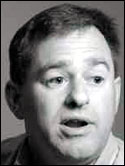
SUTTEN: Yes, Royal Caribbean has a lot of older, peculiar systems, because it’s very hard to go out and retrofit a ship. So the guideline we’ve been using on all open source, and not just Linux, is that if it’s higher up in the architecture, at the logic layer or the presentation layer, and the life of the product is somewhat limited to three to five years, we were pretty happy using open source. We think it’s sustainable; it’ll last for that time. But as we move further down, to the data layer, the operating system layers, we’ve been pretty hesitant, because we expect 10 to 20 years out of that level in the application. And so we’ve been hesitant going in that direction.
Photographs by Thom O’Connor (Rick Carey, Paul Cormier, Jonathan Eunice, Jason Matusow, Stuart Robbins, George Weiss, Steve Yatko), Jeffrey Salter (Mike Sutten), and Chuck Nacke (Stacey Quandt).